

 www.woodsmithplans.com ```html
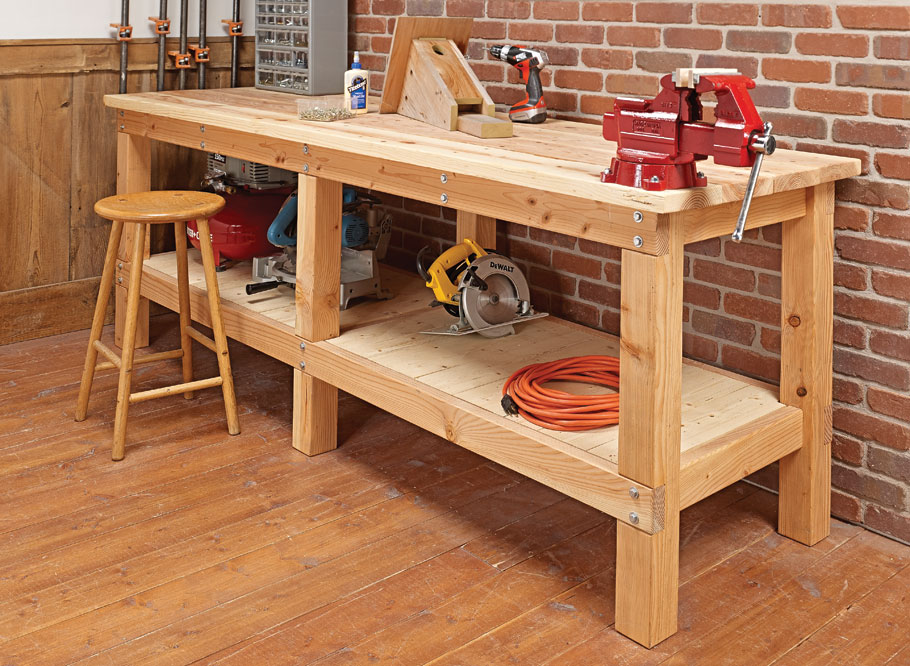
 Introduction: The Ultimate DIY Workbench Ready to level up your workshop? This post will guide you through building a robust 187+ cm workbench, complete with a pegboard for tool organization and a sturdy vise for secure clamping. This workbench is designed for functionality and durability, making it a valuable addition to any DIY enthusiast's workspace.
Materials and Tools Needed: To start, gather your materials and tools. Having everything on hand will streamline the building process.
- Wood: (All dimensions are approximate and can be adjusted to suit your needs)
- (2) 4x4 posts, 90 cm long (for legs)
- (4) 2x4s, 187 cm long (for front and back frame)
- (4) 2x4s, 60 cm long (for side frame)
- (3) 2x4s, 53 cm long (for inner supports)
- (1) Plywood sheet, 187 cm x 60 cm (for workbench top)
- (1) Plywood sheet, 187 cm x 60 cm (for pegboard backing)
- (1) Plywood sheet, 187 cm x 30 cm (for pegboard front)
- Hardware:
- Wood screws (various sizes, e.g., 3", 2", 1.25")
- Lag bolts and washers (for vise mounting)
- Pegboard hooks and accessories
- Tools:
- Circular saw or table saw
- Drill and drill bits
- Screwdriver or impact driver
- Measuring tape
- Pencil
- Clamps
- Level
- Safety glasses
- Hearing protection
- Vise
Step 1: Building the Base Frame Start by constructing the frame that will support the workbench.
- Cut the 4x4 posts to the desired length (90 cm). These will be the legs.
- Assemble the outer frame using the 2x4s. Connect the 187 cm long pieces to the 60 cm long pieces to form a rectangular frame. Use wood screws to secure the joints.
- Ensure the frame is square. Use a level to ensure it's level.
- Attach the legs to the inside corners of the frame using wood screws. Make sure the legs are flush with the top of the frame.
- Add the inner supports (53 cm 2x4s) between the side frames. Space them evenly for added stability. Secure with wood screws.
Step 2: Attaching the Workbench Top Now, secure the plywood sheet to the frame to create the work surface.
- Place the plywood sheet (187 cm x 60 cm) on top of the frame.
- Align the edges of the plywood with the edges of the frame.
- Use wood screws to attach the plywood to the frame. Space the screws evenly around the perimeter and across the inner supports.
Step 3: Installing the Vise Install the vise on the workbench for clamping materials.
- Determine the desired location for the vise on the workbench top (usually near a front corner).
- Mark the mounting holes for the vise on the workbench top.
- Drill pilot holes through the workbench top at the marked locations.
- Secure the vise to the workbench top using lag bolts and washers. Tighten the bolts securely.
Step 4: Constructing and Mounting the Pegboard Create and attach the pegboard for organized tool storage.
- Layer plywood sheets(187 cm x 60 cm) and (187 cm x 30 cm)
- Screw the two layers together to give the pegboard extra thickness
- Attach the pegboard backing (187 cm x 60 cm) to the back of the workbench frame, above the work surface. Use wood screws to secure it in place.
- Attach the Pegboard front (187 cm x 30 cm) to the top of the Pegboard Backing with wood screws
Step 5: Finishing Touches and Organization Complete the workbench and organize your tools.
- Sand any rough edges or splinters on the workbench.
- Apply a finish to the workbench top (optional). This will protect the wood and make it easier to clean.
- Attach pegboard hooks and accessories to the pegboard to organize your tools.
- Organize your tools and supplies on the workbench and pegboard.
Conclusion: Your Custom Workbench is Ready! Congratulations! You've successfully built your own 187+ cm workbench with a pegboard and vise. This sturdy and functional workbench will provide a solid foundation for your DIY projects for years to come. Enjoy your organized and efficient workspace!
``` 14 Super-simple Workbenches You Can Build — The Family Handyman
 www.familyhandyman.com
 Simple Workbench Plans
 www.pinterest.com
 Heavy-duty Plank Workbench
www.woodsmithplans.com


0 komentar:
Posting Komentar